Showing posts with label simulator. Show all posts

2013-03-24

HF on the ATtiny15

I wanted my class E amplifier to be driven by an Attiny15. The idea is to build a HF (6.78MHz) low voltage and low power beacon.
The maximum PWM frequency attainable using the factory OSCCAL value, and using OCR1B=2 and OCR1A=1 is 8.525MHz with the only possible duty cycle is 33%. With OCR1B=3 we get 6.393MHz, OCR1B=4 we get 5.115MHz.

I want to use my beacons in the ISM band of 6.78MHz so the second value (OCR1B=3) is the closest. I managed to output a duty cycle of 25% (OCR1A=1) or 50% (OCR1A=2), this is perfect for a class E drive as 50% is available. The final tuning was done with trial and error on the OSCCAL value until I got the correct frequency.
In my tests, the factory value for OSCCAL (of all the Atmel Tiny15L I tested) would get you within 1% of the nominal frequency 1.6MHz, but with frequency measurement and tuning I got to within 0.5%.

Did a couple of other idiot measures and observations.
- The program memory of the ATtiny loops, the PC is only 9bits and when the last instruction of Program memory is reached execution continues for 0000.
- A NOP consumes less current that an rjmp +0, not significantly but noticeable. I fill the memory with each instruction and measure the current with or without BOD. The second instruction also take double the time of execution.

RJMP+0,BOD - 3537uA (AVG)
RJMP+0,NO BOD - 3494uA
NOP,BOD - 3503uA
NOP, NO BOD - 3458uA

- OSCCAL after reset is cleared and the measured clock frequency is 1.1MHz, when taken to 0xFF the frequency is 2.083MHz.
- Clock jitter of the oscillator. I filled the program memory with the following:
lp000:
.rep64
sbi portb,portb1
cbi portb,portb1
.endr
rjmp lp0000

I would then trigger the scope at the low level at the end of the loop. This gap would last longer than normal, then it is easy to trigger on it. You can just see it under the trigger arrow in the picture above.


I would the trigger to the flank increase persistence to max and let measure. the jitter.


The waveform goes up quite fast (in less than 10ns) with the oscilloscope probe as load. With a gate of MOSFET... it's not so good...

2013-03-02

Class E - selecting a switch

After the initial results (with a simulated ideal switch) here, had to design a real circuit. Having seen a lot of projects with the 2N7000 and having a few in my surplus bin, I used it in the simulation.
Finding spice models for the 2N7000 is easy, being the only problem that there are so many. I used the typical Coss of 2N7000 (11pf) and subtracted from C1 in the Sokal 2001 formulas.
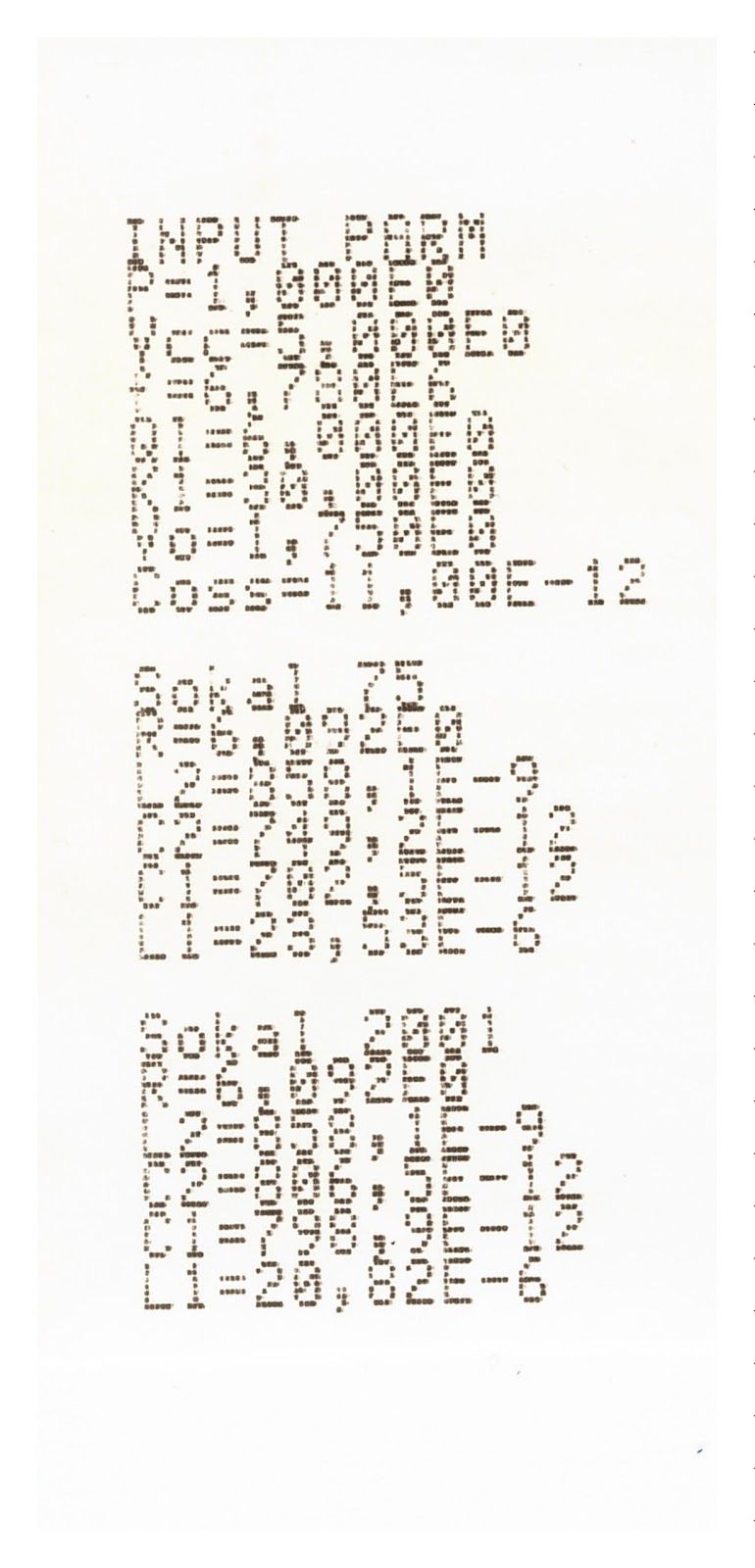
In order to stop working at the PC for so long, I started using the calculator more often to find optimum parameters and just do a short simulation at the PC. Here's the print out from the calculator.

QL is the Qload of the circuit, K1 is the ratio of XL1 to XC1 (unadjusted) (mentioned in Sokal 2001), one could do some iterative calculations but a simple adjustment seems good enough.
Simulations, unfortunately are not handled (yet) by my HP42S... so here's the ngspice output.
Spice output using 2N7000 Vgs=5V

There was something wrong! After having a closer look at the datasheet of the 2N7000, the drive voltage was clearly a problem. My system is 5V only (Vcc and Vdrive) and it is clearly insufficient to fully drive the 2N7000. Once the drive was changed to 12V the waveforms looked much better.
2N7000 with VGS=12V

Since the system will be 5V only I had to find a logic level drive MOSFET, the ones I had available were IRLD024 or IRLR024N. Unfortunately there are no spice model available for the IRLD024 (Vishay or IR), so I will use the second one (IRLR024N) for simulation and the first one for the final circuit.
Class E with IRLR024N
This last waveform starts showing some signs of out of tune (VDS is 5V at turn-on) but the Sokal documents give hints on how to tune.

2013-02-26

Class E deambulations

I've been recently been "pointed the way" to change/learn new engineering skills and (with some reluctance at first) I decided to embrace RF (as in radio frequency) as the way to go.
As any semi-nerd-academic I started by buying the books, I bought the ARRL Handbook, the then I read a blog referencing to EMRFD. I must admit that RF always sounded difficult, complicated and away of normal engineering. Like a cult or a secret society. No information was ever revealed.... Finding a book having "Experimental" on the title caught my attention and showed me it was probably not the reality.

By the way, I have no plans to become a HAM, I just want to try and learn RF. Because of that I have to use the ISM bands available (and within reasonable power less than 2W, radiated probably less than 0.1W).

I'm still reading (in the engineering way) both books, but after some reading I decided it was time to build something.

Having worked in power electronics (and in the light of my new "interest") I decided to build something I knew was used both in RF and induction heating, a class E amplifier/driver but I had no personal experience.
Class E was defined by the N. and A. Sokal in 1975 with a US patent 3'919'656
(Nov 11, 1975) and in 2001 new refined design equations were presented in QEX Jan/Feb 2001 (also by N. Sokal).

My requirements are simple to start with output power 1W, a 5V supply, a Vswsat 1V, operating frequency 6.78MHz (ISM band and I also have a Short Wave receiver that receives this frequency), Qload 6. This is all you need, if you use the 2001 formulas determining L1 will be iterative (the 1975 formulas should be OK and are not iterative).

Having seen a few pages (here, here and here) using the 2N7000 and having tons of them, I decided to use it in the project.
Being a bit academic I calculated the values, substituted the NMOS with a voltage controlled switch and simulated the circuit.

Schematic for simulation of a Class E Amp
The results were very encouraging...
Voltage and Current in the Class E Amp

In the picture above v(500) is the switch voltage, v500#branch is the switch current and the v(900) (sinusoid) is the load voltage. The power in the switch was also relatively low with an average below 1W (V500 is a 1V source to simulate a voltage drop in the switch). This without tuning the circuit (but also without a real 2N7000). 
Power through the Switch
At this stage, I saw enough to go to the second step, simulate with a "real" 2N7000, but that's another story.

2008-10-18

Using a CP/M Simulator

Since I started the project I started searching for CP/M simulators. In order to boot and use my system I needed a tool to build CP/M (assembling the CCP,BDOS,CBIOS and CBOOT), and transfering files to the disks. I found many that are a bit outdated here, and two great simulators with loads of cp/m software ready to run: Z80pack and SIMH/Altairz80 .

I setteld with Altair Z80 SIMH because it suited better my project. On the processor side allows you to change form the standard Z80 of most simulators to a 8080 processor, you can easily reduce the memory to 32Kb, it also has the boot disks and source (although in Z80 format) for CP/M 2.2, CP/M 3, and MP/M II. Finally and also very important, not only it supports the disk format I wanted to use (3.5 inch 1.44Mb, i.e. as used by P112) as also supports accessing the floppy disk directly.

As recommended here, I used a image file to transfer the files and then used NTRAWRITE to transfer the files to the floppy. I am using a USB 3.5 inch drive and the other usual tools to read and write CP/M disks didn't work as they used direct access to the UPD765 in regular PC.
The procedure is easy, start altairz80 and type in:
sim> set hdsk1 format=p112
sim> attach hdsk1 \\.\B:
sim> show hdsk1
HDSK1, 1474KB, attached to \\.\B:, P112, WRTENB, QUIET,
T:160/N:18/S:512
sim> go

At the moment I can only use CP/M 3 for reading and writing the disk images, because for CP/M 2.2 one needs to adapt the bios specifically for each hard disk.
When all the files have been transferred to the disk image, close the simulator and use NTrawrite to write the floppy image into the floppy.